
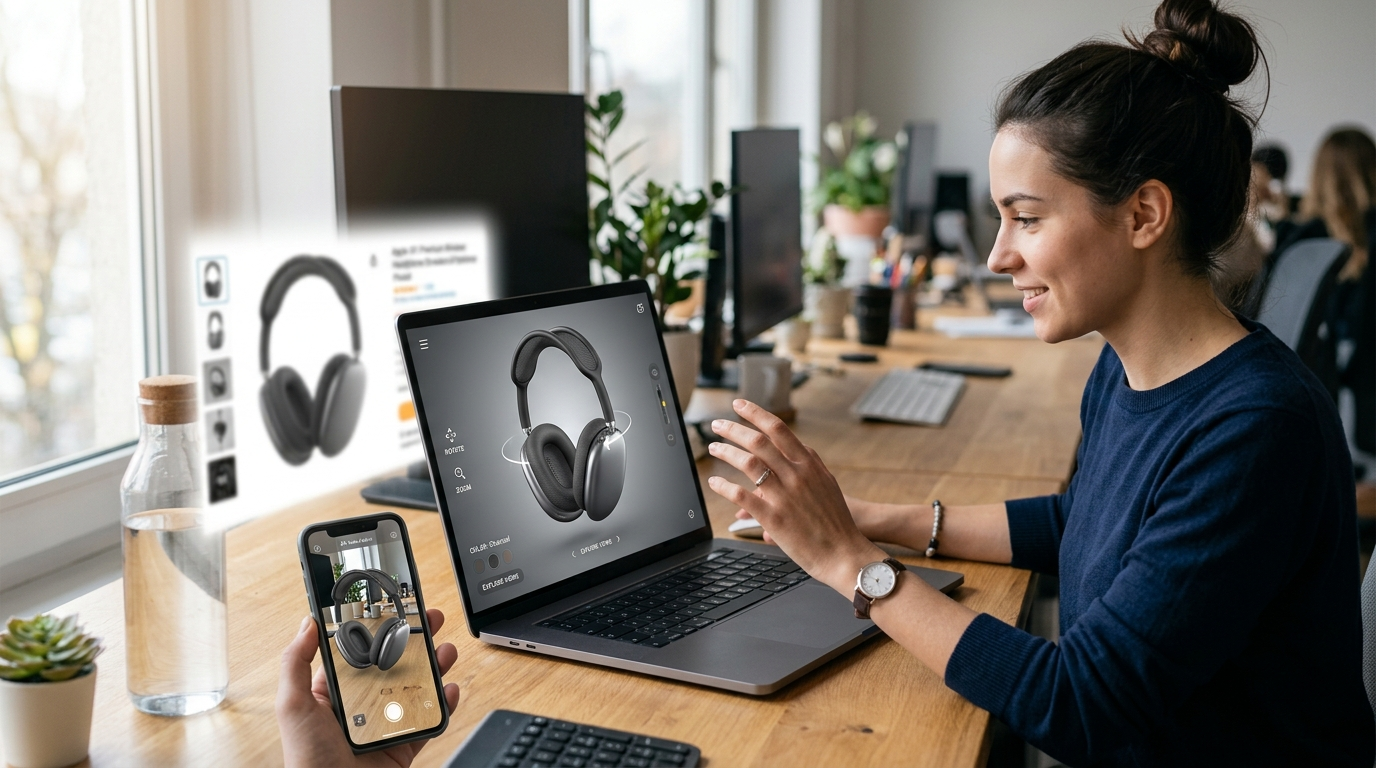
There's a peculiar kind of anxiety that comes with buying something online. You've scrolled through a dozen photos, read forty reviews, and still found yourself wondering: will this actually look right in my living room? Or: is this shade of blue closer to navy or teal? The static image on your screen holds its answer somewhere, but it won't give it up easily.
For decades, that uncertainty was simply the price of convenience. You bought the thing, waited for it to arrive, and either kept it or sent it back. Returns became a multi-billion-dollar industry, not because people are indecisive, but because flat photographs were never really designed to replace the experience of holding something in your hands.
That's beginning to change and the shift is more fundamental than it first appears.
The Limits of the Flat Image
To understand why product visualization matters, it helps to consider what traditional e-commerce photography could never do.
A photograph captures a moment, a single angle, a fixed lighting condition. It tells you what a product looks like in a studio, not what it will look like in your kitchen, on your wrist, or against your skin tone. It compresses a three-dimensional object into two dimensions and then asks you to reverse-engineer reality from that compression.
This isn't a failure of photography. Photography is extraordinary at what it does. The failure was in assuming it was enough that if you showed someone a product clearly, they had enough information to feel confident buying it.
Confidence, it turns out, requires more than clarity. It requires interaction.
What Interactivity Actually Gives You
When we talk about interactive product experiences, we're talking about a fairly wide family of tools: 360-degree product views, augmented reality try-ons, real-time configuration engines, 3D model viewers, virtual room planners. What connects them isn't the technology. It's the underlying shift they represent.
They give the shopper agency.
Instead of being shown a product, you get to explore it. You can rotate a shoe to see its sole. You can place a virtual sofa in your actual living room through your phone camera. You can swap the color of a jacket and watch it change in real time. These aren't gimmicks; they're answers to questions that a static image simply cannot address.
Product visualization, at its core, is about closing the gap between "what this looks like" and "what this would be like" and that gap is exactly where doubt lives.
The Psychology Behind the Change
There's good reason this matters beyond the practical. Shopping, especially for things that will enter your daily life clothes, furniture, electronics, home goods is partly an act of imagination. You're not just buying an object; you're buying a version of your future self who owns that object.
When product visualization tools let you simulate that future more accurately, they do something psychologically significant: they move the decision from abstract to concrete. The mental leap required to commit shrinks. The doubt that usually lingers until the package arrives starts to resolve before checkout.
Research across consumer behavior has consistently found that people are more likely to purchase and less likely to return when they feel they understood what they were getting. Interactivity doesn't just improve the experience; it improves the accuracy of expectations. And more accurate expectations mean fewer surprises, fewer returns, and more satisfaction.
Not Just for Big Retailers
One of the more interesting developments in this space is how accessible these tools have become. Five years ago, building an interactive 3D product viewer required specialized software, expensive rendering pipelines, and months of development work. That barrier has dropped considerably.
Web standards have matured. Browsers can now render complex 3D scenes without plugins. Augmented reality on mobile devices once a novelty has become a standard feature of most smartphones. And a growing ecosystem of platforms means that smaller retailers and independent brands can now offer the same kinds of interactive experiences that were once exclusive to well-funded tech companies.
This democratization matters because it shifts product visualization from a competitive advantage into something closer to a baseline expectation. Shoppers who've placed virtual furniture in their homes using one retailer's app will notice the absence of that feature everywhere else.
Where the Friction Still Lives
None of this means the transition is seamless. There are real challenges that the industry is still working through.
Creating accurate 3D models of products at scale is time-consuming and expensive, even if the cost has dropped. Not every category benefits equally a bag of coffee or a book doesn't gain much from a 360-degree view. And augmented reality, for all its promise, still requires users to opt in, download an experience, or hold their phone at an awkward angle for long enough to see the result.
There's also the question of accuracy. A product visualization is only as useful as it is truthful. If the colors render incorrectly on different screens, or if the virtual sofa looks slightly smaller than its real dimensions, the tool can actually make things worse replacing one kind of uncertainty with another.
Trust is still the underlying currency. Interactivity earns trust only when it's reliable.
A Shift in What "Seeing" Means
What's quietly happening in online retail is a renegotiation of what it means to see a product before you buy it.
For most of e-commerce's history, "seeing" meant looking at photographs. Good ones, hopefully. Multiple angles. Maybe a video. But essentially, you were a spectator. The product was presented to you.
Interactive product experiences change the role of the shopper. You become a participant. You investigate. You test configurations. You place the object in your own context and observe how it behaves there.
That's a more honest kind of seeing and it turns out people are willing to make better decisions when they're allowed to do it.
The Broader Implication
The shift toward interactive product visualization is about more than convenience or even confidence. It reflects a deeper change in how we think about digital experiences in general.
We've grown accustomed to information being something we navigate rather than something that's handed to us. Search engines let us find what we're looking for rather than waiting to be shown it. Social media let us curate rather than simply consume. Streaming lets us choose rather than schedule. Interactivity is the expectation across almost every digital domain.
Online shopping, for a long time, was the exception. You were shown things. You could filter and sort, but the core experience was essentially passive a catalog with a search bar.
The move toward interactive product experiences is online shopping catching up to that broader expectation. The product page is becoming less of a billboard and more of a fitting room.
Whether that's a better way to shop is something each person will answer for themselves usually right around the moment they successfully place a virtual lamp in their corner and realize it's exactly the wrong size.
That feedback, at least, is honest. And it arrives before the box does.